If you have ever pressed TUNE, watched the SWR drop, and thought the antenna itself was suddenly “fixed,” you are not alone. An antenna tuner is one of the most useful pieces of HF gear in a station — but its name is a little misleading.
The tuner does not usually change the physical antenna. Instead, it changes the impedance the radio sees so the transmitter can work into a load that is close to the 50 ohms most modern transceivers expect.
What the tuner actually does
An antenna system includes the antenna, feed line, connectors, and anything else between the transmitter and the radiating element. If that system does not present roughly 50 ohms at the radio, the transmitter sees a mismatch and the SWR rises.
A tuner uses combinations of inductance and capacitance to transform that impedance. From the radio’s side of the tuner, the load can now look close to 50 ohms, allowing the transmitter to deliver power normally instead of reducing output to protect its final amplifier.
That is the real job: impedance matching.
What it does not do
A station tuner does not magically remove the mismatch that exists farther down the line. If the antenna and feed line create a high SWR on the antenna side of the tuner, that standing-wave condition is still there after the tuner finds a match.
This is why a beautiful 1:1 reading at the radio does not automatically mean the entire antenna system is efficient. The tuner can make the transmitter happy while loss is still occurring in the coax.
Why feed-line loss matters
All feed lines have loss, even when perfectly matched. With coax, a high SWR adds additional loss because RF energy makes repeated trips through a lossy transmission line before it is ultimately radiated or dissipated. The effect becomes more important with longer coax runs, higher frequencies, and higher SWR.
High SWR can also create higher RF voltage or current at points along the system. That can stress coax, connectors, tuner components, and other hardware if the mismatch and power level are severe enough.
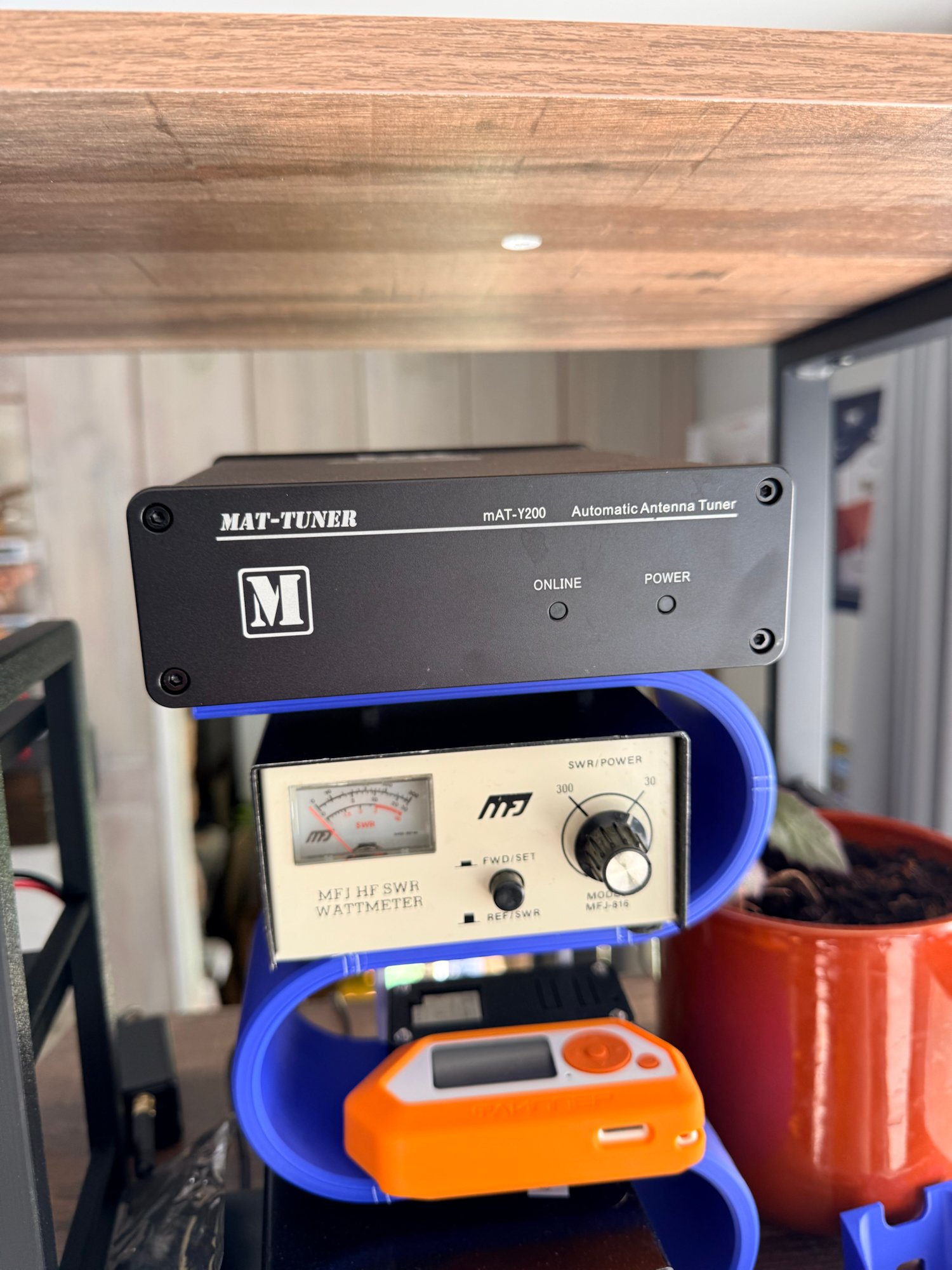
Where the tuner sits makes a difference
A tuner located in the shack protects the radio and gives it a good match, but the coax between the tuner and antenna can still be operating at high SWR. A remote tuner mounted at or near the antenna feed point can transform the impedance before the signal travels through the coax. That can substantially reduce mismatch-related coax loss in systems where the untuned feed-point impedance is far from 50 ohms.
This is one reason remote automatic tuners are popular with non-resonant wires and some portable or multiband installations.
A practical portable example
Suppose you set up a portable vertical on 40 meters and the analyzer shows 3.5:1 SWR. A tuner at the radio may easily make the transceiver see 1.2:1. You can transmit, and the radio is satisfied — but the coax between the tuner and the antenna still has the original mismatch.
If instead you adjust the whip, coil, or radial system until the antenna itself is near resonance and presents a reasonable match, the feed line operates under easier conditions. The tuner may then need to make only a small correction, or no correction at all.
The best way to think about a tuner
Think of an antenna tuner as a matching network, not an antenna repair device. It is extremely useful when an otherwise workable antenna presents an impedance your radio does not like. It can broaden the usable range of an antenna system and make multiband operation much more convenient.
But it cannot turn a poor radiator into a great one, recover power already lost as heat in the feed line, or replace good antenna design. Whenever possible, start with an efficient antenna, good feed line, solid connections, and a sensible installation. Then let the tuner do the job it was designed to do: provide the radio with the impedance match it needs.
Roger Quintana, NJ2RQ — LuffyHamVault.com
Further reading
For deeper reading, see ARRL’s “More About Antenna Tuners” and “Feed Lines”, which explain the same distinction between matching the transmitter and changing the actual SWR on the antenna side of the tuner.