Your noise floor sits at S7 and you can’t hear anything under it. So you blame the antenna. Then you blame the band, the neighbors, the power company, and the sun. I’ve done all of that, in that order. Here’s what I learned the hard way: a lot of the time, the antenna is innocent. The noise is riding into your shack on the outside of your own coax — and there’s a free test that proves it in five minutes, with the radio you already own.
Your feedline is secretly a second antenna
Coax is supposed to be a one-way street: signal travels inside, on the center conductor and the inside of the shield, and the outside of the shield stays out of it. In the real world, the outside of that braid behaves like a long wire antenna strung from your antenna, down the side of the house, past every wall wart, LED lamp, battery charger and switching power supply you own, and straight into the back of your radio.
Noise picked up on that outer surface is called common-mode noise, and your receiver can’t tell it apart from a real signal — because by the time it arrives, it is one. End-fed antennas are famous for it, but any coax-fed antenna can do it. The antenna hears the band. The feedline hears your house. Both of them are plugged into the same radio.
The test: five minutes, no tools, nothing to buy
You need one quiet stretch of band and your S-meter. Do it band by band, because the answer can change from 80 meters to 20.
- Write down the reading. Tune to a clear frequency — no signals, just your noise floor. Note the S-meter reading with everything connected normally.
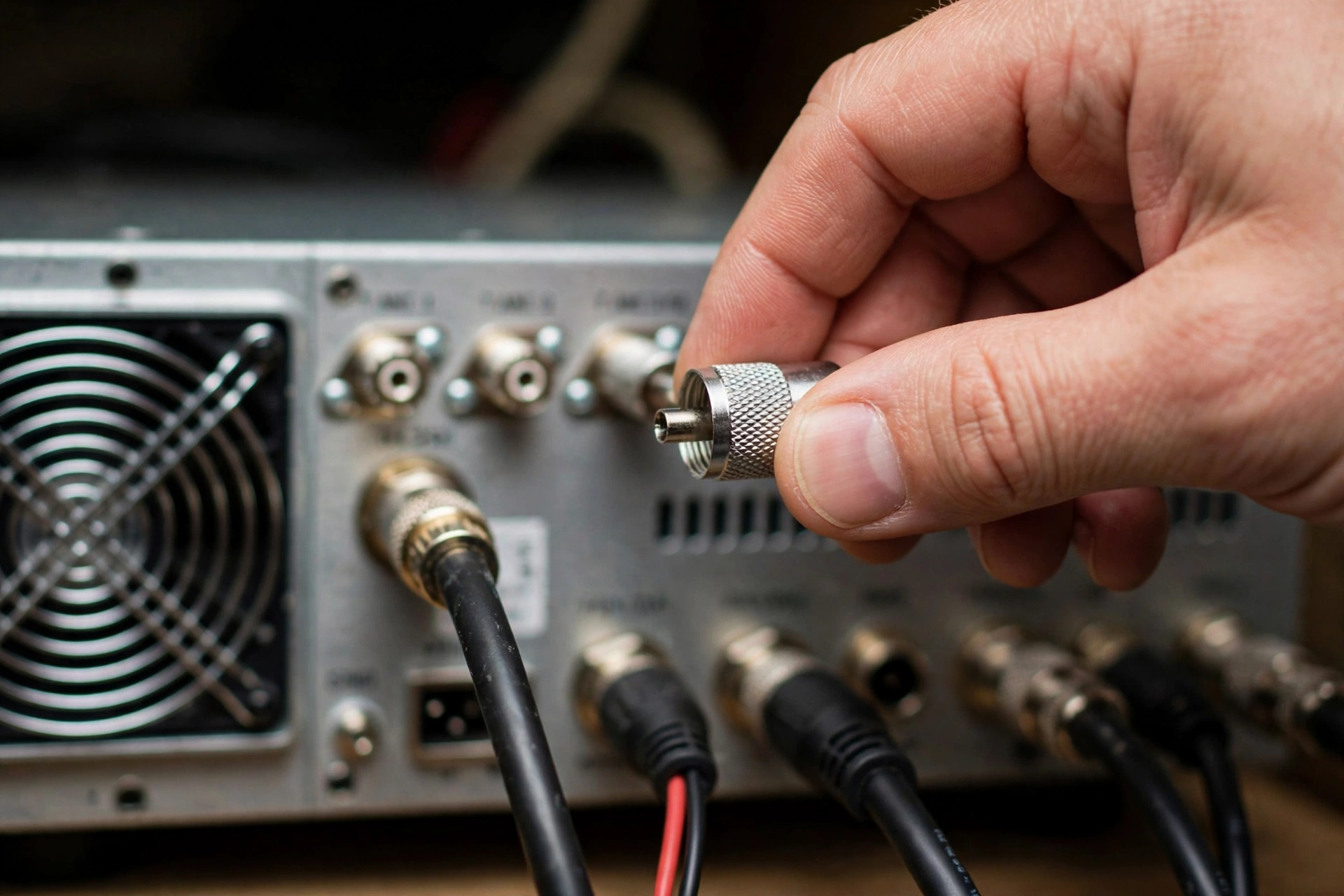
- Pull the coax off completely. Unscrew the PL-259 at the radio and move it away. The receiver should fall to near silence. That’s your baseline — the radio’s own noise, with no antenna and no feedline.
- The center-pin test. Now plug the connector back in partway: push just the center pin into the socket and leave the shell unscrewed, so the center conductor is connected but the braid is not. Note the S-meter again.
- Screw the shell down and take the third reading.
Now read the results like a scorecard:
- Pin-only reading close to the unplugged baseline, big jump when you screw the shell on: that jump is noise arriving on the outside of your coax. Your antenna is fine. Your feedline is the antenna you didn’t know you had.
- Pin-only reading already high, little change when the shell goes on: the antenna itself is hearing that noise out of the air. No choke will fix it — that’s a different hunt (find the source, or accept the band as it is).
- Most shacks get a mix: some noise on the braid, some in the air. Fix the braid part first. It’s the part you control.
The fix, in the order I’d do it
Kill noise at the source first — it’s free. While you’re at the radio, have someone walk the house unplugging wall warts, LED bulbs, phone chargers and cheap power supplies one at a time while you watch the S-meter. Anything that drops the needle when it dies is a noise source you can replace or filter for good.
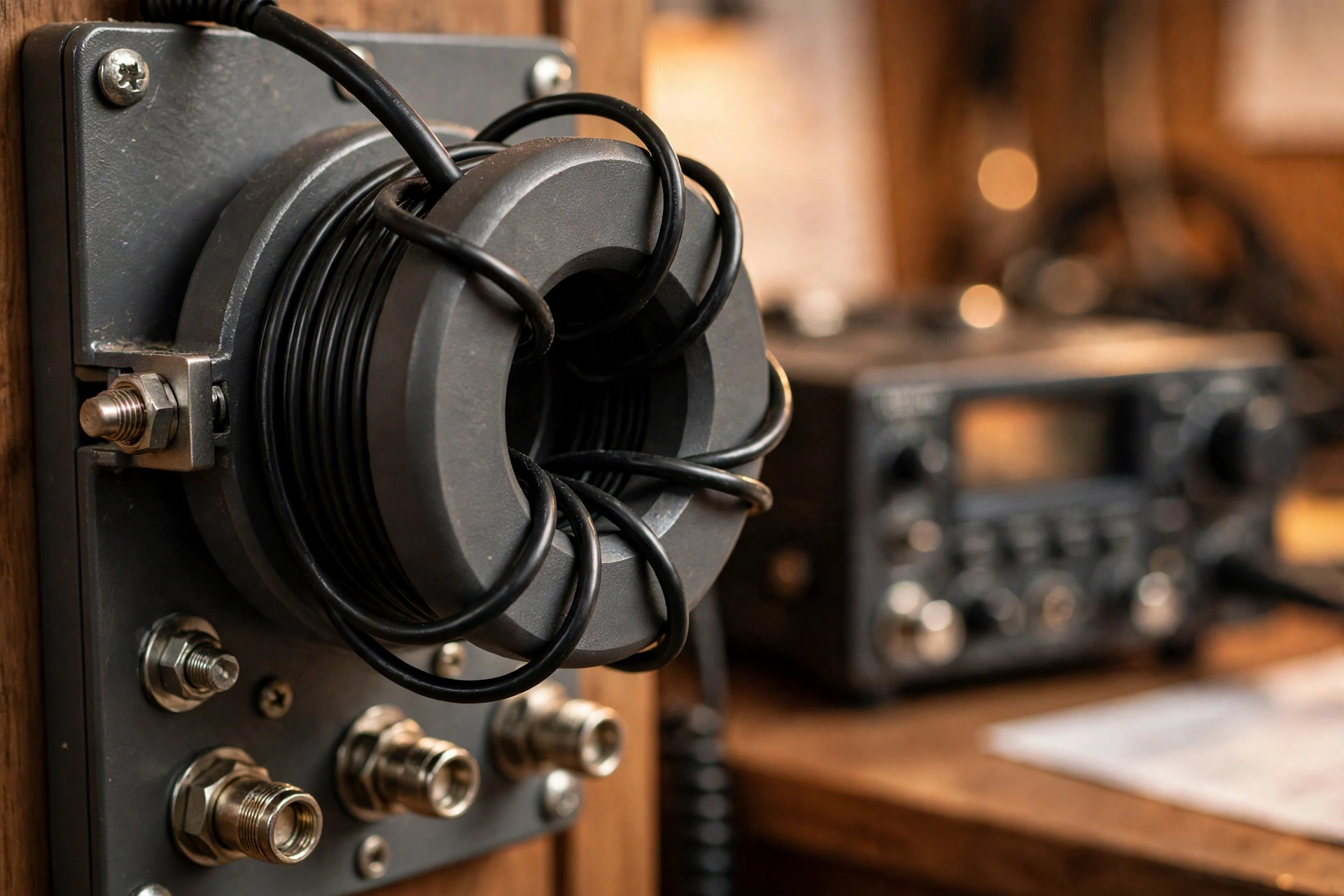
Then choke the feedline where it enters the shack. A proper common-mode choke is your coax wound through a large ferrite toroid — Mix 31 is the material you want for the low bands — several turns, placed at the shack entry point. Two warnings from experience:
- A single snap-on bead is nearly decoration on 80 and 40 meters. It doesn’t have enough choking impedance down there. One big wound toroid beats a string of snap-ons.
- Placement matters more than quantity. Put the choke before any antenna switch. A switch ties all your coax braids together, so a choke after the switch protects nothing — choke each feedline as it comes in, ahead of the switch, and the whole shack gets quieter.
Know the limit. A choke stops noise traveling on your feedline. It does nothing for noise your antenna picks up out of the air — that’s what step 3 of the test tells you. Don’t buy ferrite to fix a problem the test says you don’t have.
What I learned / what to try
- Run the center-pin test on every band you use and write the three readings down. Five minutes of notes will tell you more about your noise than a season of guessing.
- If the shell-on jump is big, your first choke goes at the shack entry, before the switch — not at the radio, not at the antenna.
- Retest after every change, one change at a time. Noise work is detective work: change two things and you’ll never know which one mattered.
Your antenna has been taking the blame for your feedline’s crime. Run the test, read the scorecard, and fix the part that’s actually guilty.
73, Roger — NJ2RQ