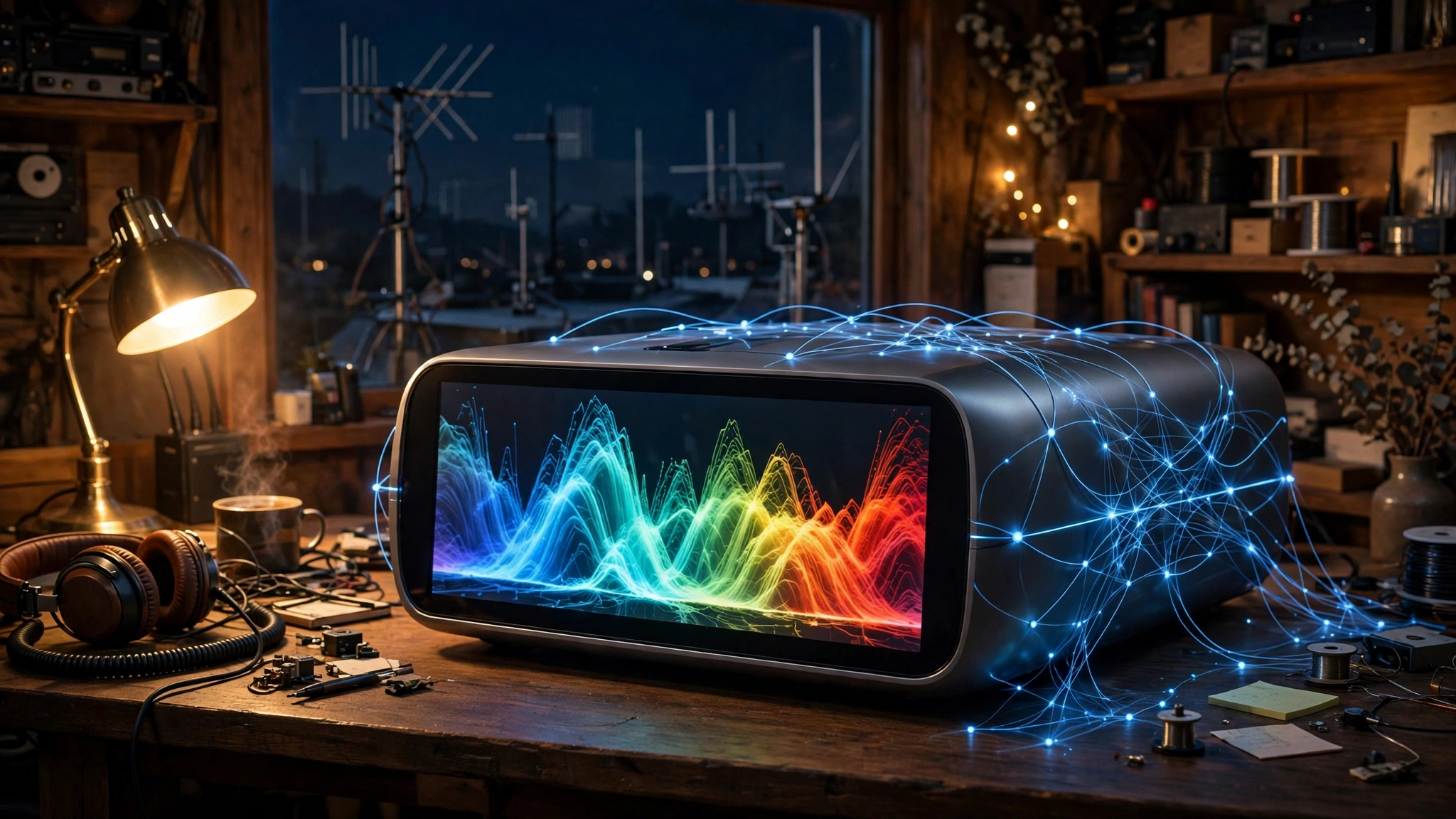
Ask a room of hams what the radio of the future looks like and you’ll start an argument. No knobs at all? A radio that finds the DX for you? Here’s my take, from a shack full of radios spanning forty years of design: the radio of the future isn’t a different box. It’s the same box with a brain — AI integrated into the receiver, AI optimizing your settings on every band, all the time, in the background.
And here’s the part that surprises people: pieces of it are already here.
What “AI in a radio” actually means
Forget the science-fiction version. In a transceiver, AI means software that was trained on real signals instead of programmed with fixed rules. Old noise reduction follows a formula: if the audio looks like this, cut that. A trained neural network has listened to thousands of hours of SSB and CW, learned what a human voice and a dit actually look like buried in noise, and rebuilds the signal you meant to hear. It’s the difference between a filter and an experienced operator riding the controls.
Applied across the whole radio, that one idea grows into a list:
- AI noise reduction that separates voice from static the way your brain does, only faster
- Automatic optimization on every band — the radio watches the noise floor and band conditions and sets AGC, filtering, preamp and attenuation for this band, right now, not a preset you saved last season
- Signal recognition — the radio labels what it hears: that’s SSB, that’s CW at about 20 WPM, that’s FT8, that’s a birdie from your neighbor’s solar inverter
- A tuner and amplifier that learn your antennas, band by band, instead of hunting from scratch every time
- A co-pilot for operating — spotting the opening, suggesting the band move before the pileup figures it out

The future is already shipping — quietly
Here’s what most hams miss: nobody launched “the AI radio” with a big announcement. AI arrived the way it always arrives in this hobby — one feature at a time.
Software-defined radios got it first, because an SDR is a computer and a computer can run a neural network. FlexRadio’s current SmartSDR software includes an AI noise reduction built on a recurrent neural network, sitting in the DSP chain next to the traditional algorithms — and its AGC can already set its own threshold automatically by measuring the noise floor beside your slice. I own one of those radios. The future is literally on my shelf; it just didn’t come in a box labeled “AI.”
Outside the radio, hams got there even sooner. AI noise-filtering services already take your receiver’s audio, clean it on a server in real time, and hand you back SSB and CW with the noise stripped out — trained on recordings of actual amateur traffic, including recordings operators submitted of their own noise at their own stations. Third-party control software for Icom rigs now adds AI noise reduction and automatic signal classification on top of radios that shipped without either. The aftermarket is bolting AI onto yesterday’s radios while the factories take notes.
So how soon do Icom and Yaesu ship “the AI radio”?
Now the prediction — and I’ll give you the honest reasoning instead of a guess pulled from the air.
The big Japanese makers move carefully, on long product cycles, and they don’t bet a flagship on unproven software. But they also don’t ignore a feature a competitor is selling. Watch the sequence that has already started: AI noise reduction appears in SDR platforms and in software first, because software can be updated. Then it becomes a checklist feature — the thing a review mentions and a buyer asks about at the hamfest. Once it’s a checklist feature, no flagship ships without it.
So my call: the first radios marketed as AI radios from the big makers arrive within one product generation — and they’ll lead with AI receive processing, because that’s where the technology is already proven. A radio that continuously optimizes its own settings across all bands — the full vision — is one generation behind that. Not because the technology is far off, but because factories ship features in the order they can prove them: ears first, then hands, then judgment.
And notice who has the head start. The SDR makers can add AI with a software update to radios already in your shack. The traditional makers have to build it into the next box. That gap — update versus new model — is the real race.
What it won’t change
An AI radio still needs an antenna, and it will still hear the noise your antenna hears. It won’t fix common-mode noise on your feedline, it won’t quiet a bad power supply, and it won’t teach a new ham to listen. What it does is give every operator the equivalent of forty years of knob sense — the settings a veteran would have chosen, chosen instantly, on every band. The skill in this hobby was never really in the knobs. It was in knowing why. That’s still yours.
73, Roger — NJ2RQ


