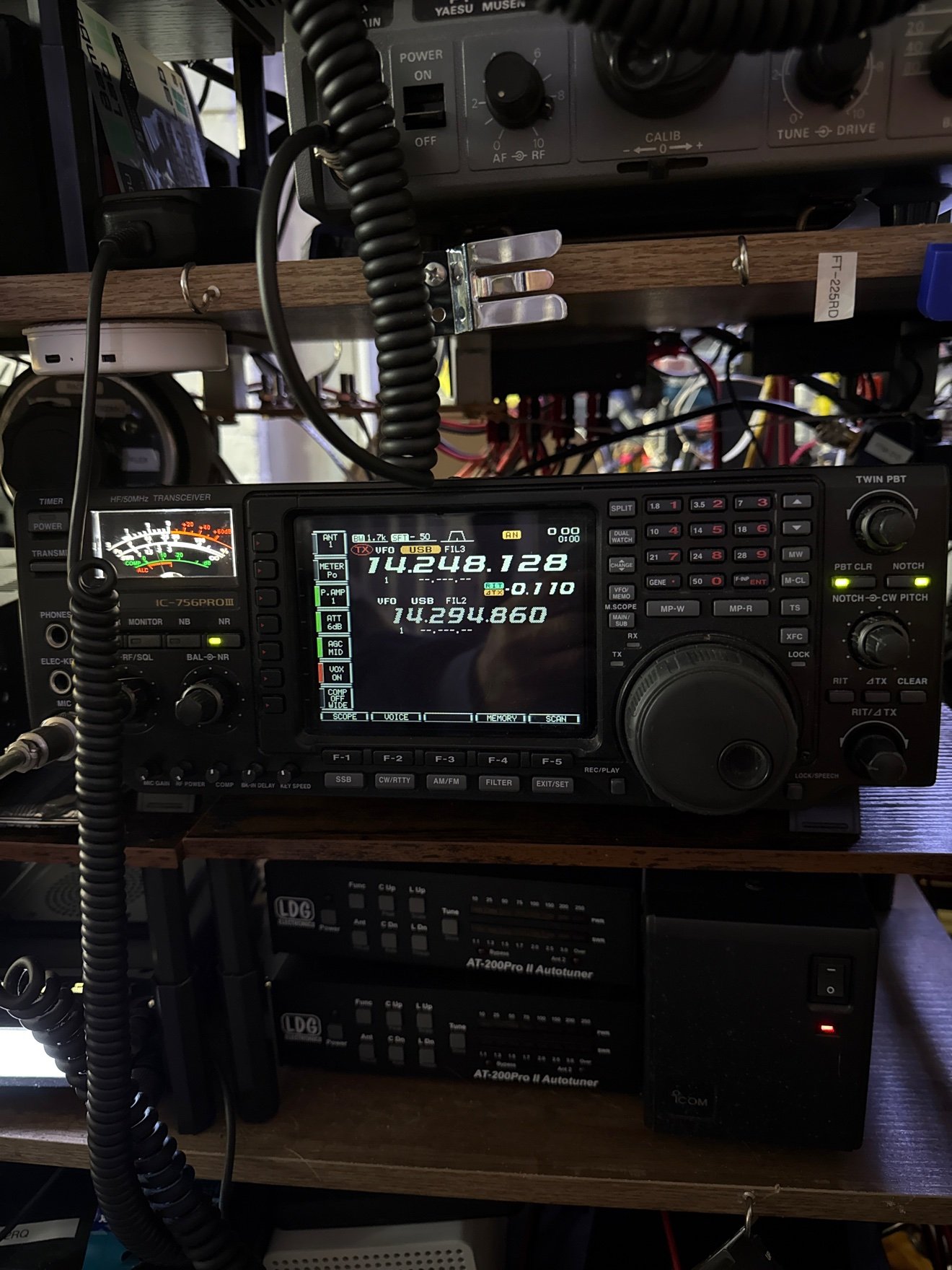
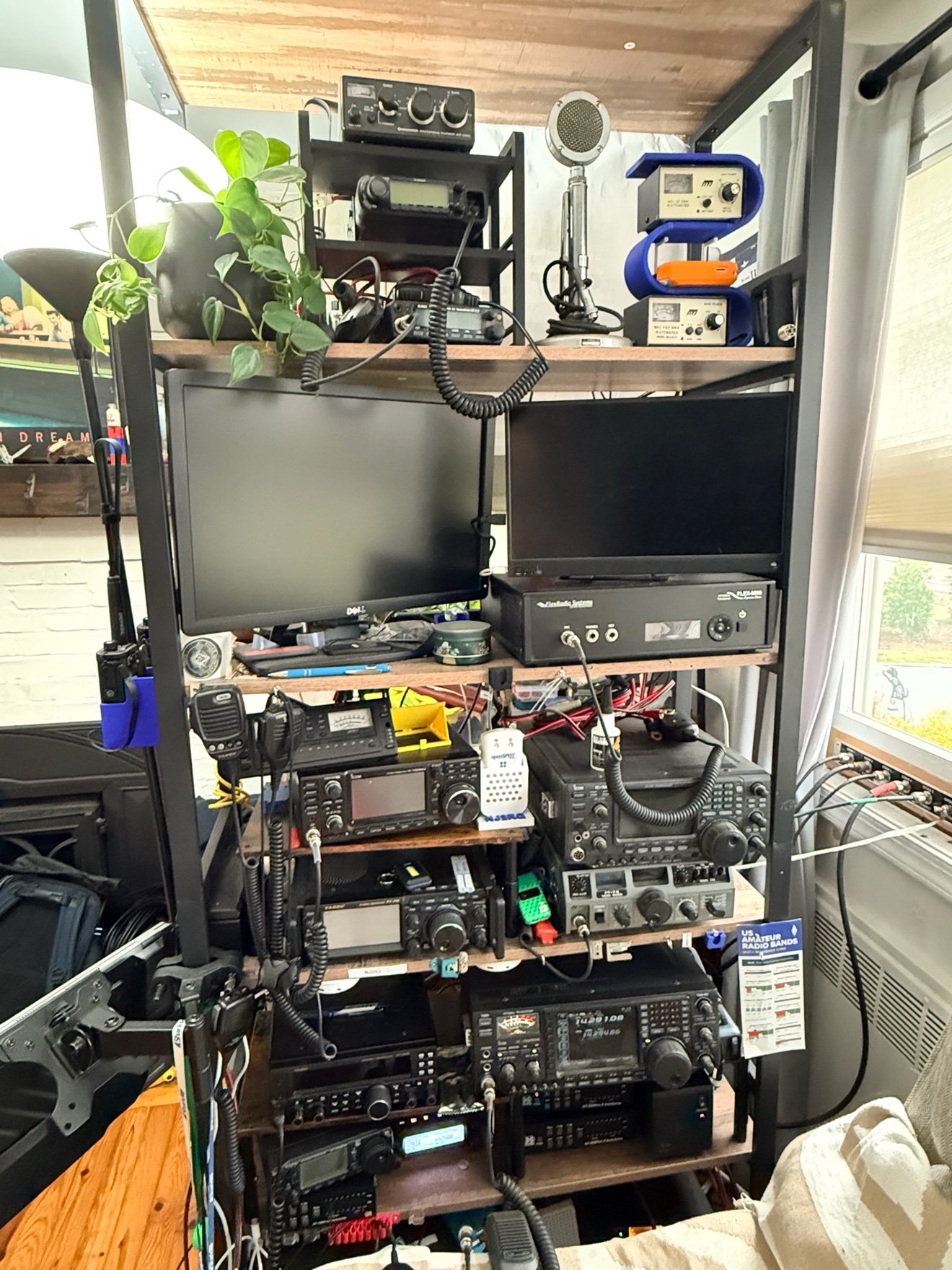
Every modern HF radio on the market — every touchscreen, every waterfall, every rig that lets you shape your own filters in a menu — is living in a house the Icom IC-756PRO series built. My IC-756PROIII sits in the rack under a FLEX-6500 and next to far newer radios, and it is not there for decoration. Here’s what this radio did first, what it still does well, and what to look for if one shows up in your shack.
What the PRO series did first
The 756PRO line stacked up a list of firsts that we now take for granted:
- First 32-bit floating-point DSP in an amateur transceiver. Filtering, noise reduction, and notch all happen in DSP at the IF — no crystal filter slots, nothing extra to buy.
- First customizable filter shapes. Soft or sharp, wide or narrow — you build the filter the band conditions need, instead of picking from whatever optional filters you happened to purchase.
- First large TFT color display on an amateur HF rig, with a real-time spectrum scope. Seeing the band — instead of just hearing it — started here for most of us.
- First mid-class HF transceiver with +30 dBm-class third-order intercept. Big-signal manners used to be flagship money. The PRO series brought them down a class.
The PROIII took the formula one step further: Icom folded receiver techniques from the flagship IC-7800 into it — a fundamental-type 64 MHz roofing filter, a new quad-JFET first mixer, redesigned preamps, and low-distortion bandpass switching — and hit that +30 dBm intercept point on 14 MHz. It also added the mini-scope (watch the band while you’re in the menus), standard 60-meter coverage on the US version, programmable SSB transmit bandwidth, and an 8-channel RTTY transmit memory.
What it still does well
- The receiver is honest. Strong-signal handling is the thing cheap radios fake and this one doesn’t. On a crowded band, signals stay separate instead of mushing together.
- Dual watch. Two signals on the same band at once — work the pileup and listen for the DX station’s listening pattern without a second receiver.
- Controls you can run by feel. Big knobs, real buttons, twin passband tuning, a manual notch with serious depth. In a contest or a net, your hands learn this radio fast.
- The scope habit. Once you’ve operated with a live spectrum scope, you never want to give it up. This is the radio that taught a generation of us to look before we call.
- It pairs with its own. Mine runs on Icom’s matching PS-125 supply — 13.8 volts at 25 amps, the supply Icom built for this radio. One less adapter, one less mystery hum.
Honest limits
- No USB audio or modern remote control. Digital modes mean an interface and cables, the way we used to do it. It works fine — it’s just not plug-and-play like a current rig.
- The scope is a scope, not a waterfall. It shows you the band in real time, but there’s no history scrolling under it. Newer radios spoiled us there.
- It’s a big, heavy, analog-era box next to an SDR. Rack space and shelf strength are real considerations.
- Age is the tax. Any radio of this generation deserves a check of the display, the tuner relays, and the cooling fan before you trust it on the air.
Before you buy one used
- Power it up cold and watch the display — bright, even, no flicker.
- Run the auto tuner through every band and listen for lazy relays.
- Check full output into a dummy load on each band.
- Work the main dial and every encoder — scratchy encoders are the common wear item.
- Ask about the fan and whether it’s ever been serviced.
A clean PROIII is not a compromise radio. It’s the machine that defined what a modern HF rig is supposed to be — and on the air, it still behaves like it.
What I learned / what to try: Put an older flagship-class radio next to your newest one for a week and run the same nets on both. The gap is smaller than the spec sheets say — and the older radio will teach you operating skills (listening, filtering, watching the band) that a waterfall does for you automatically.
73 de NJ2RQ