Portable HF antennas are always a compromise among performance, space, weight and setup time. For Parks on the Air (POTA), an end-fed half-wave, a loaded vertical and a Hamstick can all work well—but each fits a different kind of activation. In my own portable antenna collection, I have a MyAntennas EFHW-4010, a Wolf River Coils Platinum-series vertical and Hamsticks for 20, 30 and 40 meters. The best choice is the one that fits the site and the amount of time available.
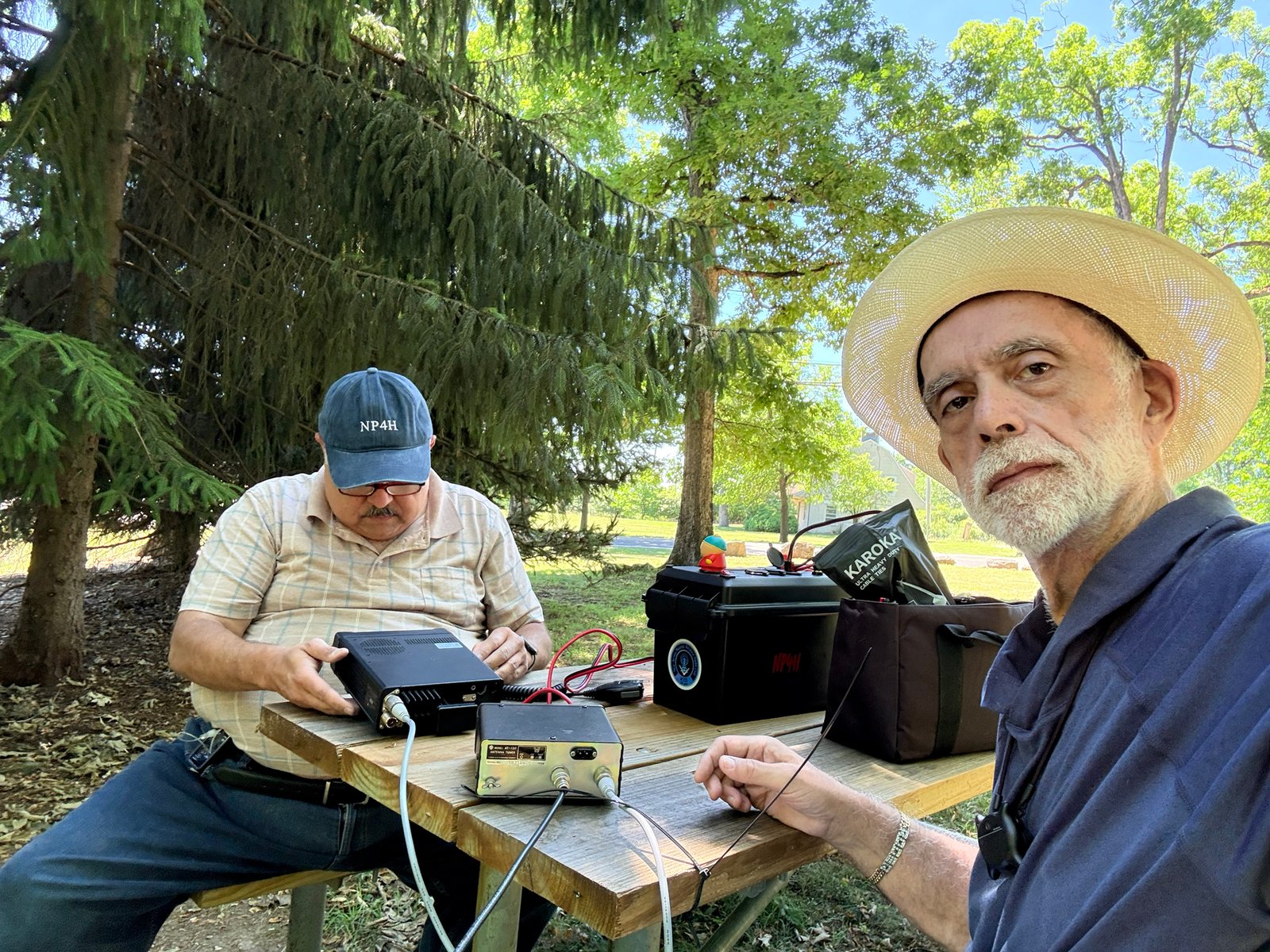
NJ2RQ operating portable amateur radio at Washington Rock State Park.
End-Fed Half-Wave: Lightweight Multiband Operation
A properly designed end-fed half-wave (EFHW) is light, compact and useful when a tree or mast is available. Most commercial EFHW antennas use a high-ratio impedance transformer, often around 49:1. A 40-meter EFHW is commonly designed for operation on 40, 20, 15 and 10 meters because those bands are harmonically related. Actual SWR still depends on the antenna design, installation height, wire configuration and surroundings, so an analyzer should be used and a tuner may still be helpful at some frequencies.
The wire can be installed as a sloper, inverted-V or inverted-L. An EFHW also needs an RF return path. Depending on the design, that may be a short counterpoise, part of the feed line, or both. Letting the coax provide that path can also place common-mode current on the feed line, so follow the antenna maker’s instructions and use a suitable common-mode choke where recommended. Do not assume that every end-fed wire is an EFHW: a nonresonant “random wire” normally uses a different transformer and usually requires a tuner.
Portable Vertical: Small Footprint and Good DX Potential
A portable vertical is useful in an open park, on a beach or anywhere overhead supports are unavailable. A typical portable system combines a telescoping whip, loading coil, tripod or ground stake, and radial wires. Compared with a low horizontal wire, a well-installed vertical often favors lower-angle radiation, which can help with longer-distance contacts. It is not automatically a better DX antenna, however; ground losses, coil loss, radial layout, terrain and propagation all matter.
Radials are a working part of the antenna—not just an SWR accessory. Use the number and length recommended by the manufacturer. Quarter-wave radials can work well, but portable systems often use several shorter wires because they are easier to deploy. For example, the Wolf River Coils Platinum TIA package is supplied with three 33-foot radials. Tune the system by adjusting the whip length and coil tap, then verify it with an antenna analyzer or the radio at low power. Saltwater near a vertical can improve low-angle performance, but that benefit should not be confused with simply placing a vertical on dry sand.
Hamstick: Fast, Rugged and Band-Specific
A Hamstick is a shortened, loaded mobile antenna with a 3/8-24 threaded base and adjustable whip. It is rugged, inexpensive and quick to install, but it is normally a single-band antenna. Because it is physically short—especially on 30, 40 and 80 meters—it is less efficient and has narrower usable bandwidth than a full-size antenna.
On a vehicle, a Hamstick depends on a sound mount and the vehicle body for its RF return path. A magnetic mount must make an effective capacitive connection to a sufficiently large metal surface; it should not be assumed to work properly on a nonmetallic panel. On a tripod or ground stake, add radials or another counterpoise. Two identical Hamsticks can also be mounted opposite each other on a purpose-built dipole adapter. That balanced configuration does not use ground radials, although it still needs careful tuning and adequate support.
The best portable antenna is the one you can deploy safely, tune correctly and use confidently at the site you actually have.
Which One Should You Pack?
Choose the EFHW when you want lightweight multiband coverage and have a suitable support. Choose the vertical when space is tight or there are no trees, and you can spread out its radials. Choose a Hamstick when speed, ruggedness and single-band operation matter most—especially from a vehicle. Before transmitting, inspect the installation, keep people clear of the radiating elements, check SWR at low power and retune whenever you change bands or significantly change the setup.
Bottom line: none of these antennas wins everywhere. Matching the antenna to the location and operating goal gives you a better chance of a productive activation.
73,
Roger Quintana, NJ2RQ
Leave a Reply