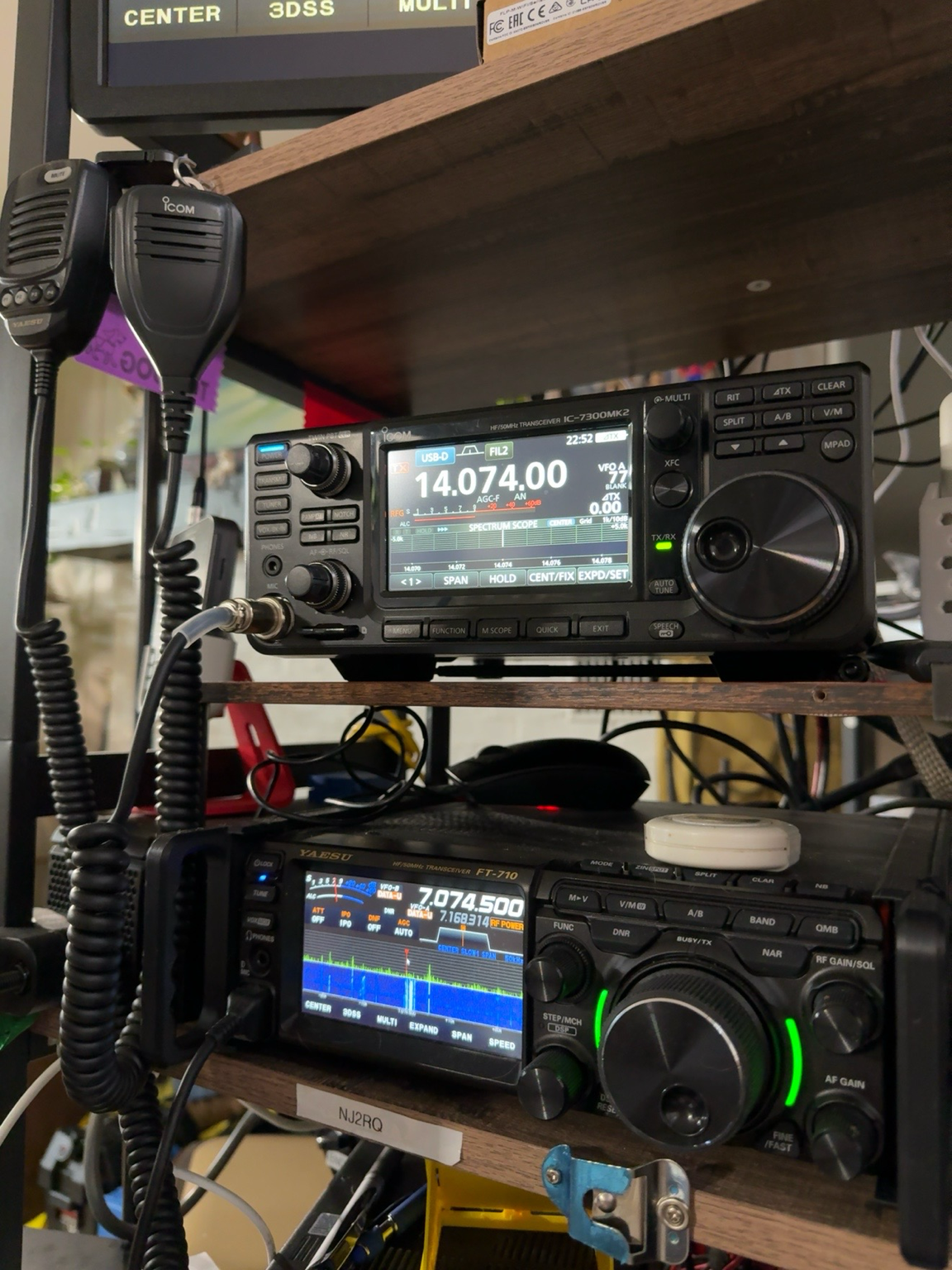
FT8 has been around since 2017, which is a long time in the fast-moving world of amateur-radio software. Yet in 2026 it remains one of the busiest and most recognizable digital modes on the HF bands. Tune to a common FT8 frequency during a band opening and the waterfall can look packed from one side to the other.
That staying power is not an accident. FT8 combines excellent weak-signal performance, a very narrow signal, short operating cycles, worldwide activity, and a setup that works with everything from modest home stations to serious DX installations.
What FT8 Actually Does
FT8 was introduced in July 2017 as part of WSJT-X. The mode was developed by Steven Franke, K9AN, and Joe Taylor, K1JT. Its name reflects those developers and its eight-tone frequency-shift keying format.
According to the current WSJT-X technical documentation, an FT8 signal occupies only about 50 Hz. A transmission lasts about 12.6 seconds inside the familiar 15-second transmit/receive sequence. The protocol uses strong forward-error correction and is designed specifically to make reliable contacts when signals are weak.
That combination is the heart of FT8: it does not try to carry a long conversation. Instead, it moves the essential information needed for a valid amateur-radio contact efficiently and reliably.
Reason No. 1: It Works When the Band Sounds Dead
One of FT8’s biggest attractions is its ability to decode signals that may be difficult or impossible to copy by ear. The current WSJT-X documentation lists an FT8 decoding threshold around -21 dB under its reference conditions.
That does not mean propagation rules disappear. You still need a path between stations, a usable antenna, reasonable noise conditions, and proper station setup. But FT8 can often make something useful out of marginal openings that would produce little or no comfortable SSB copy.
For operators with smaller antennas, limited power, HOA restrictions, portable installations, or simply less-than-perfect conditions, that can make the difference between watching a quiet band and putting contacts in the log.
Reason No. 2: There Are Always Stations to Work
A digital mode is only useful if other operators are there. FT8 has solved that problem through sheer participation.
ARRL continues to describe FT8 as the most popular amateur digital mode for DX and award chasing. A check of PSK Reporter on October 29, 2026 showed well over a million FT8 reception reports in the preceding two-hour window, far ahead of the other listed digital modes at that moment.
That worldwide activity creates a useful feedback loop: operators choose FT8 because stations are there, and stations remain there because operators keep choosing FT8.
Reason No. 3: It Fits a Modest Station
You do not need an exotic station to operate FT8. A typical setup needs an HF transceiver, an antenna, computer audio between the radio and software, CAT control if desired, and accurate computer time.
Many modern radios provide USB audio and CAT control through a single cable. The IC-7300MK2 is a good example of a modern FT8 setup. Other radios work perfectly well with an external sound-card interface such as a DigiRig or similar device.
The important part is clean setup. More transmit power is not automatically better. Audio should be adjusted so the transmitter stays clean without excessive ALC action or overdrive. FT8’s weak-signal capability is most useful when everybody keeps their transmitted signal clean.
Reason No. 4: The Operating Rhythm Is Easy to Learn
FT8 follows a predictable sequence. Stations transmit in alternating 15-second periods, and the software decodes multiple signals after each receive period. A typical QSO exchanges call signs, grid or signal report information, acknowledgments, and a final confirmation.
For a new digital operator, that structured workflow makes the mode approachable. Once the radio, audio levels, time synchronization, and software are configured correctly, operating becomes very repeatable.
It is also easy to watch propagation develop in real time. Programs such as WSJT-X or JTDX can send reception reports to PSK Reporter, while logging and mapping programs can help show where your signal is being heard.
Reason No. 5: The Frequencies Are Easy to Find
FT8 activity generally gathers around well-known conventional dial frequencies. Common examples include:
- 40 meters: 7.074 MHz
- 30 meters: 10.136 MHz
- 20 meters: 14.074 MHz
- 17 meters: 18.100 MHz
- 15 meters: 21.074 MHz
- 10 meters: 28.074 MHz
- 6 meters: 50.313 MHz
WSJT-X includes conventional working frequencies in its frequency table, although operators should always follow current band plans, license privileges, local regulations, and any special operating guidance.
FT8 Is Not Trying to Replace SSB or CW
FT8 sometimes gets criticized because the contact is highly structured and the computer performs much of the decoding and sequencing. That criticism misses an important point: FT8 is designed for a different type of operating.
If you want a long conversation, personal storytelling, or the sound and skill of voice or CW, FT8 is not a substitute. If you want to explore propagation, chase DX, work toward awards, test an antenna, make contacts under weak conditions, or see what a low-power station can accomplish, FT8 is extremely effective.
There is room in amateur radio for all of it. For a closer look at the mechanics of a contact, see FT8 Without the Confusion: What Your Radio Is Actually Doing When You Make a Contact.
Why FT8 Still Matters in 2026
The most impressive thing about FT8 is no longer that it is new. It is that the mode has become part of the everyday operating landscape.
Nearly a decade after its introduction, FT8 continues to bring activity to bands that might otherwise seem quiet. It gives modest stations access to worldwide contacts, provides a practical way to observe propagation, and keeps a large international community active on the air every day.
At NJ2RQ, that is what makes FT8 worth keeping in the toolbox. It is not the only way to enjoy amateur radio, and it should not be. But when the goal is to find out where the band is open and put a difficult contact in the log, FT8 remains remarkably good at the job.
Leave a Reply