Working a rare DX station in a pileup is one of the most satisfying parts of HF operating. It is also one of the easiest places to create unnecessary interference if your split setup is wrong.
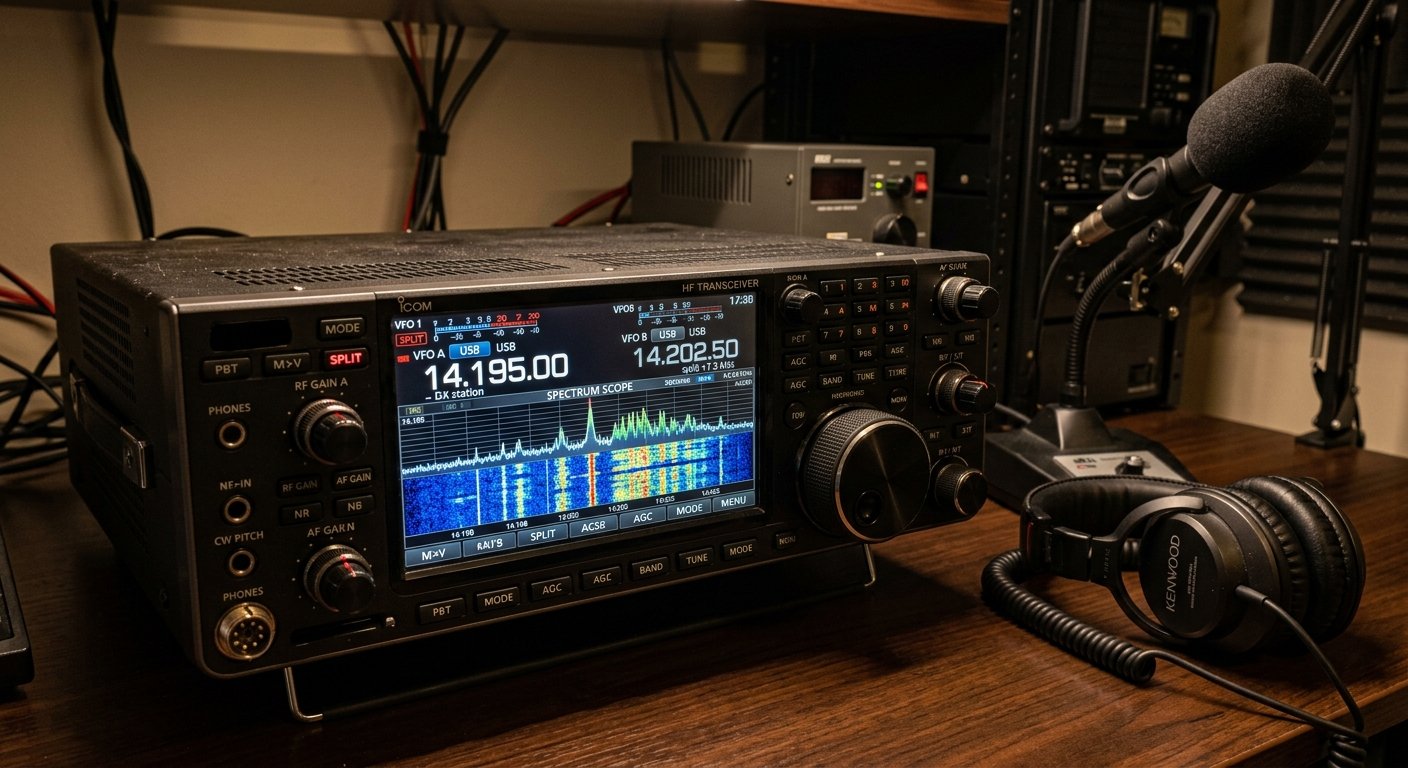
The good news is that split operation is not complicated once you understand what the DX station is doing: you listen on one frequency and transmit on another.
What “up 5” actually means
Suppose a DX station is transmitting on 14.195 MHz and says, “up 5.” You keep listening to the DX on 14.195, but your transmitter goes roughly 5 kHz higher, around 14.200 MHz. If the operator says “up 5 to 10,” they are listening across a range rather than on one exact frequency.
That is the whole purpose of split: keep dozens or hundreds of callers from transmitting directly on top of the DX station’s signal.
Listen before you touch PTT
The first job is not calling. It is listening.
Before transmitting, figure out:
- the DX station’s correct call sign,
- whether the operator is working simplex or split,
- whether they said up, down, or gave a range,
- whether they are calling for a specific region or call-sign number, and
- where the stations being answered are actually transmitting.
ARRL’s DX guidance emphasizes that you should not call a station you cannot hear and that once the DX operator acknowledges another caller, everyone else should stop transmitting until that contact is finished.
Set up the two VFOs carefully
On a typical modern HF transceiver, VFO A can stay on the DX station while VFO B is set to your transmit frequency. After enabling SPLIT, confirm which VFO will transmit before you call.
This is where mistakes happen. If the VFOs are reversed, you may transmit directly on the DX frequency and cover up the very station everyone is trying to hear.
Use the radio’s display, split indicator, TX-frequency preview, or VFO swap function to verify your transmit frequency without blindly keying the microphone.
Your transmit frequency still has to be legal
A DX station can listen anywhere that is legal for that station, but you must transmit only where your license and operating rules allow. For U.S. operators, that means checking your authorized band and mode segment before transmitting. A split instruction does not override your license privileges.
This becomes especially important when working international stations whose band allocations differ from ours.
Find the operator’s pattern
Calling exactly “up 5” every time is not always the best approach. A skilled DX operator may tune slowly through a listening range or jump around within it.
Listen to the stations the DX is actually working. If you can hear or see where the successful callers are transmitting, you can often identify the operator’s pattern and place your next call intelligently instead of transmitting blindly.
A panadapter or second receiver can make this easier, but careful listening works too.
Call once, then listen
Send your full call sign clearly, then listen. Repeating your call continuously only adds to the pileup and can make it harder for the DX operator to pull out anyone’s call.
If the DX operator comes back with a partial call that is not yours, stay quiet. If they ask for a particular number or geographic area that does not include you, stay quiet. Your turn will come faster when everyone follows the operator’s instructions.
Do not become the pileup police
Someone will eventually transmit on the wrong frequency. It happens. Resist the temptation to key up and correct them.
Sending “UP!” over and over usually creates even more interference. ARRL has specifically advised operators not to become pileup policemen. Let the DX operator manage the pileup and concentrate on your own operating.
A simple split checklist
- Hear and identify the DX station first.
- Determine exactly where the DX is listening.
- Set RX and TX VFOs correctly.
- Confirm your transmit frequency is legal for your license and mode.
- Listen for the DX operator’s rhythm and pattern.
- Send your full call once, then listen.
- Stop calling when another station is being worked.
- Never transmit on the DX frequency unless the operator is working simplex.
The real advantage is discipline
Breaking a pileup is not just about having the biggest amplifier or antenna. Knowing your radio, listening carefully, understanding the operator’s pattern, and transmitting at the right moment can make a major difference.
Set split correctly, stay inside your privileges, and make your call count. That gives you a better chance of putting the DX in the log without becoming part of the interference.
Roger Quintana, NJ2RQ — LuffyHamVault.com
Further reading
ARRL has useful guidance in Chasing DX and its article Advice to Avoid DXpedition Confusion. U.S. operators should also check the current ARRL Band Plan and FCC operating privileges before transmitting.
Leave a Reply