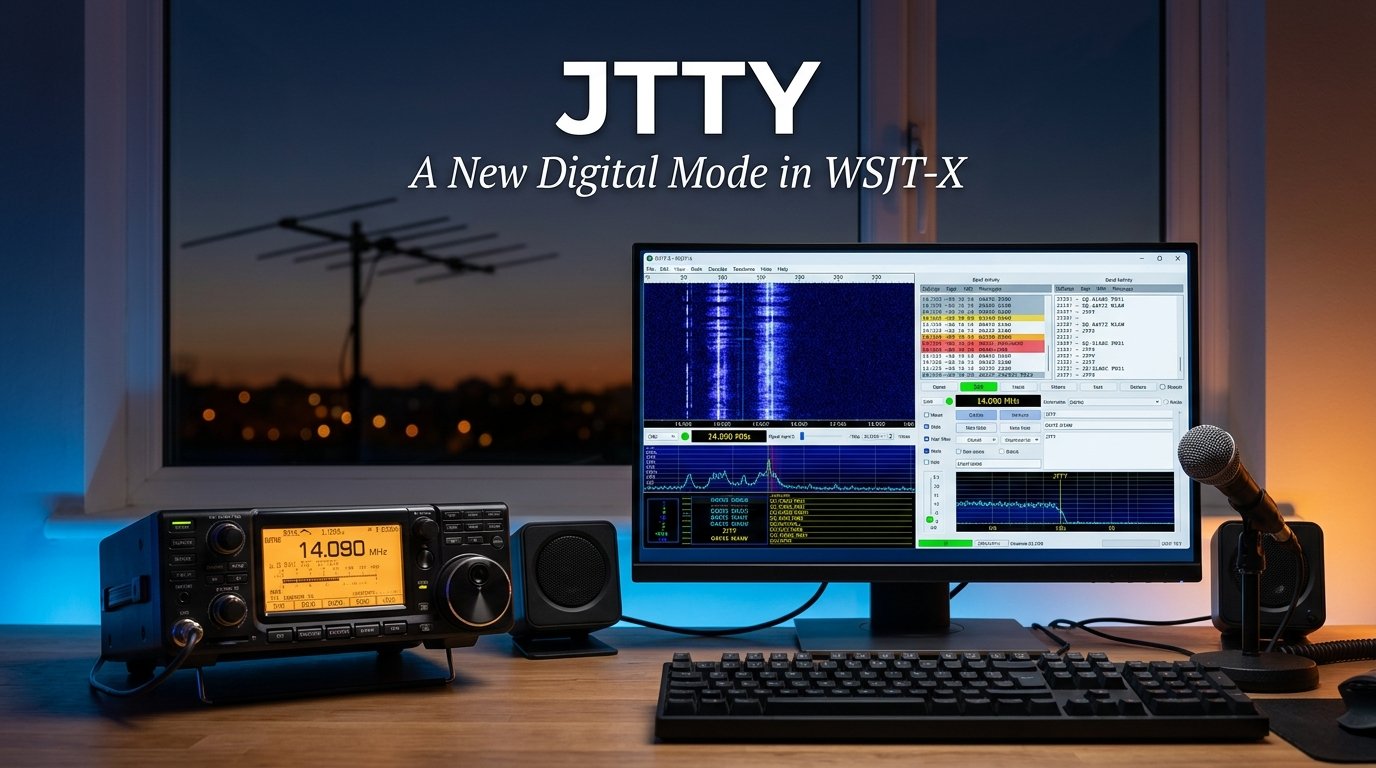
Amateur radio digital operating just got a very interesting new option. JTTY is an entirely new digital mode being introduced in WSJT-X 3.2.0-rc1, and it is designed to bring together two things many operators have wanted for years: the conversational, keyboard-to-keyboard feel of RTTY and the weak-signal performance we have come to expect from the WSJT family of modes.
This is not simply another timed FT8-style exchange. JTTY transmissions can begin whenever the operator is ready, and they normally last only a few seconds. That makes the operating experience feel much more like traditional RTTY while using modern coding and error-correction techniques.
What Makes JTTY Different?
According to the official WSJT-X documentation, JTTY was created for fast RTTY-like contest exchanges as well as ordinary keyboard-to-keyboard communication. The developers describe its operating feel as similar to standard RTTY, but with substantially better weak-signal performance and a much lower error rate.
For normal free-text conversations, JTTY can deliver about 30 words per minute. For the short fixed-format messages commonly used in contests, throughput can reach roughly 60 words per minute.
Unlike FT8 and FT4, JTTY does not require you to wait for a fixed 15-second or 7.5-second transmit cycle. You can transmit when you are ready. For operators who enjoy digital weak-signal work but miss actually typing messages back and forth, that may be the most important feature of all.
Is JTTY Replacing RTTY?
Not yet. RTTY has decades of history, a huge contest following, and widespread software support. JTTY is brand new and is still being tested in release-candidate software.
But the idea is compelling: keep the familiar operator-controlled style of RTTY while improving copy on weak signals and reducing errors. If JTTY develops a strong user base, it could become a very useful mode for contesting, DXing, experimentation, and everyday keyboard QSOs.
Where Can You Find JTTY Activity?
The WSJT-X development team has suggested 14.090 MHz on 20 meters as an initial common meeting place. The suggested frequencies are still preliminary and may change as the mode develops.
| Band | Suggested JTTY Dial Frequency |
|---|---|
| 160 m | 1.838 MHz |
| 80 m | 3.575 MHz |
| 40 m | 7.090 MHz |
| 30 m | 10.140 MHz |
| 20 m | 14.090 MHz |
| 17 m | 18.100 MHz |
| 15 m | 21.090 MHz |
| 12 m | 24.920 MHz |
| 10 m | 28.090 MHz |
| 6 m | 50.160 MHz |
| 2 m | 144.160 MHz |
What Do You Need to Try It?
If your station is already set up for FT8 or FT4 with WSJT-X, you probably already have the hardware you need: an SSB-capable radio, computer audio interface or built-in USB audio, and CAT/PTT control as appropriate.
The important point right now is that JTTY is part of the WSJT-X 3.2.0 release-candidate branch. The current general-availability release listed by the WSJT-X project is still 3.0.2, so operators trying JTTY should understand that they are testing prerelease software and that details may change.
Why I Think JTTY Is Worth Watching
FT8 proved how effective modern weak-signal digital modes can be, but it also changed the rhythm of digital operating. JTTY moves some of the control back to the operator. You type, transmit, listen, and respond when you are ready.
That gives JTTY an appealing combination: weak-signal capability, free-text conversation, fast contest exchanges, and no fixed FT8-style time slots.
Will it become the next big digital mode? It is too early to know. But it is one of the more interesting new amateur-radio modes to appear in WSJT-X in a while, and I plan to keep an eye on it.
If you already operate FT8, tune around 14.090 MHz and see whether JTTY activity is beginning to appear.
73,
Roger – NJ2RQ
Sources:
Official WSJT-X User Guide
Official WSJT-X Downloads
WSJT Development Mailing List – JTTY Suggested Frequencies
Leave a Reply